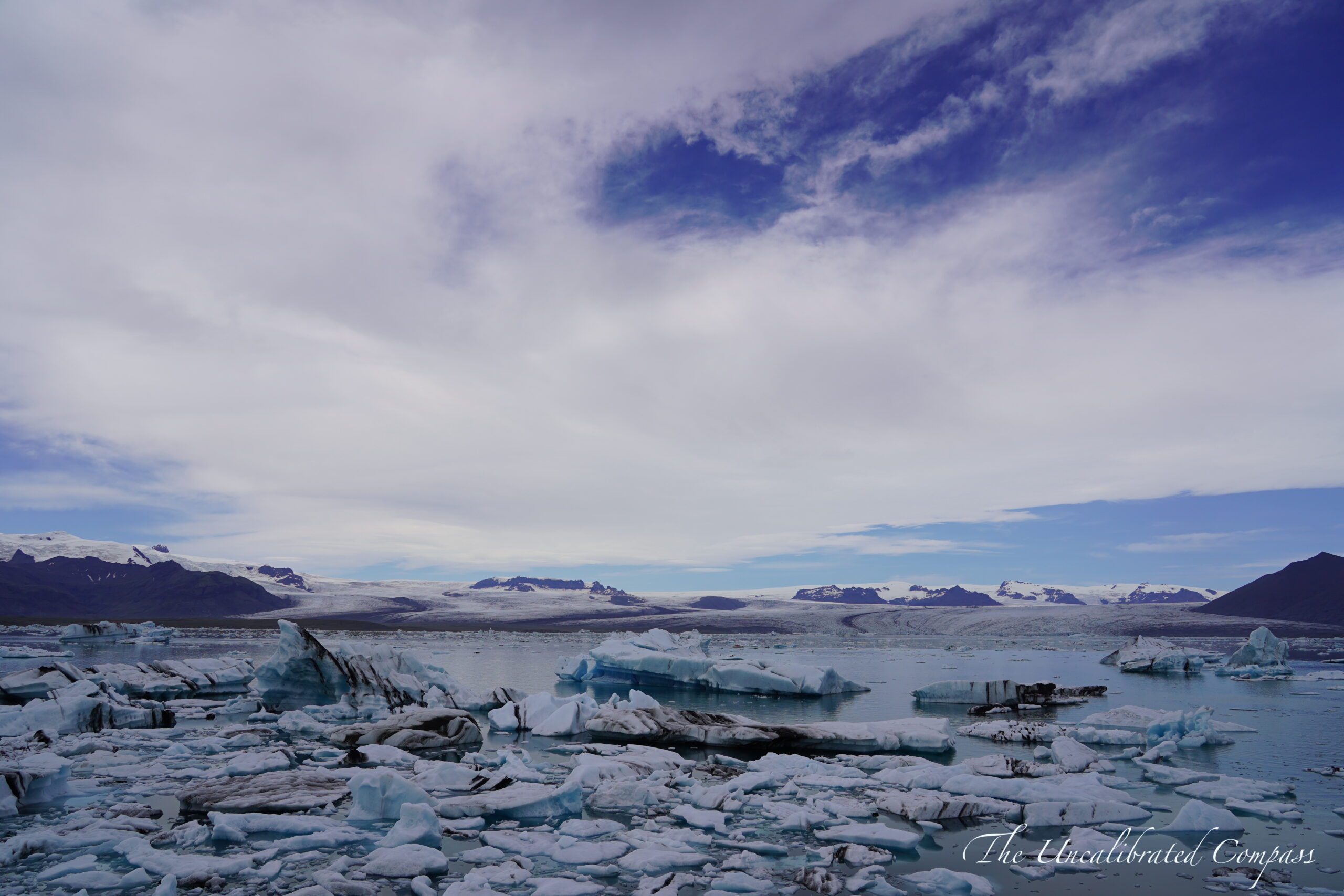
Did you know? Iceland is one of the few places on Earth where some of the world’s most powerful volcanoes are buried under hundreds of meters of solid ice. This creates an "uncalibrated" battle between fire and ice that actually reshapes the country’s map. When a volcano like Katla or Bárðarbunga erupts beneath a glacier, it doesn’t always break through the surface immediately. Instead, it melts a massive cavern of water under the ice. Eventually, that pressure becomes too much, and the water bursts out in a Jökulhlaup (a glacial outburst flood). These floods are so powerful they can carry icebergs the size of houses and create entire new plains of black sand in just a few hours. This is why the south coast of Iceland is a vast, flat desert of dark volcanic glass—it is the "debris field" of ancient battles between magma and glaciers.
Peak – summer time: June – August. Nice weather for most of the day and temperatures drop at later stages of the day. It can always get very windy in Iceland. These months provide 24-hour sunlight and all major roads are open – making the island more accessible.
Shoulder: April – May & September – October. You can experience snow storms throughout the country during these months. Good for visiting the areas close to the Reykjavik, but some roads in the eastern part of the country may be closed.
Off-Peak: November – March. These months are cold, snowy, and icy. However, these are perfect months to see the northern lights since they are the darkest months of the year. You experience 24 hours of daylight in the summer and in January you will only get four! These months are also great to visit ice caves.
Card, Cash, or both?
Credit cards are widely accepted throughout Iceland. Cash can be helpful in a very few places.
Connectivity & Tech
Network Reality: Our international roaming plan through our US carrier worked well in cities and some small towns. We had no service in the highlands or in very remote areas. Download everything you need before going on the road!
Power & Plugs: Iceland uses Type C and F (Standard European). The voltage is 230V.
My most uncalibrated experience
A drive through the north at three in the morning. Even though it was the middle of the night, the sun was still out, lighting up the road while extreme winds pushed the car from side to side. It felt incredibly raw and isolated—just us, the cliffs, and the empty road. Suddenly, we realized we weren’t alone. A huge herd of reindeer was resting right next to us in the grass, so still they looked like part of the landscape. In that moment, the harsh wind and the peaceful animals came together to show exactly what Iceland is: a place that is beautiful, tough, and completely “uncalibrated” all at once.